|
|
World premiere:
2006.04.21
Directed by:
Christophe Gans
Written by:
Roger Avary
Starring:
Radha Mitchell, Sean Bean, Laurie Holden, Deborah
Kara Unger, Kim Coates, Tanya Allen, Alice Krige,
Jodelle Ferland
Studio: TriStar Pictures
(Sony)
Official sites:
www.welcometosilenthill.com,
www.silenthill-lefilm.com
(France),
www.silenthillmovie.ru (Russia),
www.silenthill.jp
(Japan) |
|
|
|
|
|
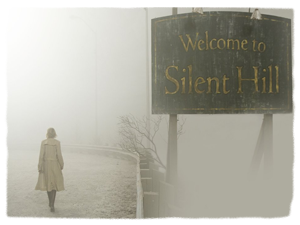
A child’s mysterious
ailment. A desperate mother. An eerie, deserted city
shrouded in mist, plagued by secrets.
The mysteries are only beginning to deepen.
When young mother Rose (Radha Mitchell) -- desperate
to find a cure for her daughter Sharon’s bizarre
illness -- refuses to accept a medical
recommendation of psychiatric institutionalization,
she flees with Sharon and heads for Silent Hill, the
town that her daughter continuously names in her
sleep. Although her husband Christopher (Sean Bean)
adamantly opposes, Rose is convinced the mysterious
town will hold all the answers. But as her car
approaches the deserted city’s limits, a mysterious
figure appears in the road, forcing Rose to swerve
and crash. When she comes to, Sharon is gone, and
suddenly Rose – accompanied by a determined police
officer (Laurie Holden) from a nearby town -- is on
a desperate quest in Silent Hill to find her child.
It’s immediately clear that her destination – left
alone since devastating coal fires ravaged Silent
Hill -- is unlike any place she's ever been:
smothered by fog, inhabited by a variety of strange,
haunted beings, and periodically overcome by a
living Darkness that literally transforms everything
it touches. As Rose searches for her daughter, she
begins to learn the history of Silent Hill – its
violent, puritanical past and the origins of its
accursed state -- and realizes that her daughter is
just part of a larger, more terrifying destiny.
|
|
|
|
| For director
Christophe Gans, the appeal of making the film of
Silent Hill lay in its otherworldliness, its mixture
of horror, sci-fi and drama elements, all the while
refusing to succumb to the rules of any one genre.
“This is a classic Twilight Zone story, dealing with
emotions and the supernatural,” says Gans. “The
story, embedded in different dimensions and linked
by the fact that everyone is suffering, rests
between the tradition of Romanesque melodrama and
surrealistic science fiction. What I like is that
Silent Hill is a current place, but once you are
caught in it, you are condemned to wander there
forever. But of course, it’s absolutely
mythological; not a normal story at all.”
It was while on the
set of Gans’ hit film Brotherhood of the Wolf,
talking with Samuel Hadida, the producer of the film
- and the man behind Metropolitan FilmExport and its
production arm, Davis Films – that the idea of
transforming the popular video game Silent Hill into
a feature film developed. Brotherhood was the pair’s
second film together after Crying Freeman and they
instantly latched onto the possibilities inherent in
creating a gripping tale and arresting cinematic
experience around the idea of a town caught between
heaven and hell, trapped by a vicious secret.
“Silent Hill is a
step beyond what we have seen in cinema,” continues
Hadida. “The video game is extraordinarily popular
because each gamer experiences something unique when
they play it. This film is going to further that
experience by adding dimension and mythology to an
already amazing concept. I first met Christophe when
I was presenting one of my films, Evil Dead at the
1982 Festival du Film Fantastique de Paris; he was
there with his short film, “Silver Slime”.
Throughout our years of working together, we have
been waiting to make a film that would be an homage
to the horror genre. Silent Hill is that homage.”
Convincing the makers of the game, Konami, to give
Gans and Hadida the rights to make the movie was no
small task, but Hadida knew the game’s richly visual
aesthetics and spooky narrative would dovetail
perfectly with Gans’ encyclopedic film knowledge.
“It’s a twisted story with enormous reference to the
cinema of today because the Japanese creators have
taken their influences from the masters of the
horror genre,” says Hadida. “Christophe, having seen
almost every film ever made, is the right person to
reference these genres.” The competition for the
rights to the game was fierce. Hadida and Gans found
that they were competing against more than a few
major Hollywood production companies. What made the
difference, and it was the only thing that made the
difference, was Christophe Gans’ vision, which he
conveyed in a thirty minute on-camera statement to
the game’s creator, who in turn took that to the
Board of Directors at Konami. Gans took home the
prize because Konami felt he was the only one who
perfectly understood the essence of the game.
Yet at the same time,
the difference in media was crucial to understand.
“A game is a game, and a film is a film,” says Gans.
“Silent Hill is about diving into a frightening
world. What was important in the idea to do a movie
was to bring a background story into the foreground.
And we wanted to make all the characters grey and
ambiguous, very multi-dimensional.”
Producer Don Carmody
had previously teamed with Samuel Hadida on the
blockbuster Resident Evil franchise, and was
immediately intrigued by what Silent Hill promised:
a movie experience “intellectually interesting,
stimulating, and definitely cinematic.” |
| |
|
The Worlds of Silent Hill |
|
|
| Integral to
understanding the complex universe of Silent Hill is
grasping the many realities and unrealities of the
place. “Silent Hill is very different from any other
film in the genre,” comments Hadida. “This is a
world that exists on four different dimensions or
levels of existence: the town of Silent Hill in the
1970s when it was real and existing, Silent Hill
now, Silent Hill in the fog state and Silent Hill in
the Darkness state. Carmody adds, “it’s an
incredibly challenging effort to show all these
levels visually and to do so, massive sets were
built, requiring five studios to accommodate them
all, and for every set, there are two or three
levels of existence.”
Two of the dimensions
have to do with time – reflecting the real Silent
Hill of thirty years ago as seen in flashbacks that
look like scratchy old film stock, and the real
Silent Hill of today, in which Sean Bean’s
Christopher has gone looking for his wife. The other
two dimensions to the town – the foggy daylight in
which Rose tries to find her daughter, and the
rust-colored, occasionally enveloping Darkness that
represents an evocation of Hell – have to do with
space. “I like this idea that we are literally
exploring dimensions of space, time and something
metaphysical, mystical,” says Gans.
Executive Producer
Andrew Mason, who came to this project with a
curriculum vitae that includes The Crow, Dark City
and the Matrix trilogy, gravitates towards
filmmakers who create a complete world. Having spent
a childhood reading science fiction, he has a
penchant for alternative realities. “This is either
a story about what happens in the moments between
death and your fate or perhaps it’s a story about
the existence of a real alternative dimension some
of us get trapped into because we deny our fate,”
says Mason. “This film deals with the terror of
loneliness, the fear of the dark, the fear of taking
responsibility for your own evil side, and the fear
of your own fate. In Silent Hill the game, the
creators put you constantly in an environment in
which everything is potentially threatening and
nothing feels like it will ever offer you comfort.
This film seeks to reproduce that experience for a
wider audience.”
And if there’s some
confusion about its altered realities, it’s
intentional, Gans says. “We do not try to explain
everything because I prefer people to find the
meaning in the dream quality of this story. It is
more pleasurable to enjoy the opacity. It is a
playful invitation to be intelligent.”
In adapting the game,
Gans did make a crucial change to the story - the
protagonist of the film is female, rather than male.
“If you deal with disturbing issues such as we do in
the film, you must have a saving grace,” he says.
“Bringing women into the story, (the cast is almost
entirely female), was my way of doing that. By
putting the issues on a feminine level, it makes
them more complex and, at the same time, more
ambivalent.”
The leitmotiv in
“Silent Hill” is motherhood, faith and persecution,
all presented on a symbolic level. Gans’ film
Brotherhood of the Wolf (which he regards as his
‘boy’s film’), features Mani, a shamanistic North
American Aboriginal who believed in the forces of
nature. Silent Hill is the feminine counterpart in
which Gans explores the force of motherhood against
intolerance. “Rose, as Sharon’s adoptive mother,
loves the child so much, Sharon becomes her own. In
this way, motherhood in the film is about
Immaculate Conception - motherhood achieved in the
noblest way. And that is the saving grace of the
film. All these female characters have different
ways of coping with motherhood.”
Complementing Rose is
Cybil, the childless police officer who adopts
Rose’s quest; Dahlia, the suffering mother who lost
her child to a fanatical sect; Christabella, the
religious leader who has turned away from motherhood
for what she believes is the greater good of the
community; Anna, the innocent who grasps onto
anything that fashioned itself as a mother; and Dark
Alessa, who tends to her namesake with all the
savagery that the maternal instinct can mobilize.
By the time Silent
Hill reaches its devastating conclusion in the
suddenly unfriendly sanctuary of a witchobsessed
cult, Gans’ film has coalesced into a cautionary
tale of the dangers of religious fanaticism that
evokes the disturbing history of witch hunting. “In
the 17th and 18th century in Europe, the witches who
were persecuted were women who wanted to be free,
who wanted to be considered as conscious entities,”
Gans details. “Monotheistic religions constantly
attack the idea of femininity and this is something
that was clearly in my mind. But I am not
moralizing. I try first to tell a story and if
audiences dig into it, they might find what I like
and what I don’t like. If someone was to watch
Brotherhood of the Wolf and then Silent Hill, they’d
have a pretty good idea of who I am.”
Mason concurs.
“Anyone who’s seen Brotherhood of the Wolf knows
there’s a very sure hand at the helm of this movie.
They’d know this was someone who enjoyed the
grandeur that cinema has to offer and who could
bring vast and amazing adventure alive on the
screen. But what they didn’t perhaps see was how
twisted and surrealist a brain he has, and this is
an opportunity for him to put those things
together.”
Cinematographer Dan
Laustsen returned to work with Gans once again,
having shot the director’s hit Brotherhood of the
Wolf. “Christophe has a very clear vision of what he
likes and it’s just fantastic,” explains Laustsen.
“I’ve never worked with anyone who knows so much
about movies. He’s completely visual. I’m sure he
has seen all the movies in the world. In the case of
Silent Hill, it is not horror, horror, horror. It’s
scary, but it’s very poetic with beautiful, sweeping
images and that’s its power.”
While adapting a game
experience to screen is similar to adapting a novel,
it is not the same. A novel is often compacted, but
this video game has been distilled. Akira Yamaoka,
the creator of the Silent Hill video game, embraced
the work of French surrealists, like Hans Bellmer
and modern artists such as Francis Bacon, blending
in a healthy serving of Kafka. “It’s logical to
approach a film version from a French surrealist
point of view, which Christophe does,” explains
Mason. “In Silent Hill, there are layers and layers
of story and every time you think you understand,
something occurs that makes you reevaluate
everything. Adapting this game is more about finding
its essence, as well as taking as much familiar
material as possible, retaining the intensity of the
mystery and suspense.”
“I cried when I
played “Silent Hill 2,” ” recalls screenwriter Roger
Avary. “It’s a beautiful piece of art and it will
always exist. But we had to disassemble it and
create something new.” Together Avary and Gans spent
hours and hours studying not just story elements and
details, but how the camera floats through the game.
“The one element we always felt we must remain true
to is the spirit of the material,” Avary continues.
“If not, then all is lost.”
And what is the
spirit of this fever dream called Silent Hill? Avary
explains, “That was the one great and true struggle
Christophe and I had. I believe in forgiveness and
Christophe believes in justified revenge, and I
think Christophe won.” Comfortable with the results,
Avary explains, “Christophe understands Silent Hill
as well as, if not better than the creators of the
game. First as a player, then as a writer and then a
director, Christophe absorbed the necessary
metaphorical elements of the material and then
layered on his and my and everyone else’s
interpretation of the material. You could have had a
million different filmmakers do their own
interpretation of this, but there aren’t any who are
as media hungry as Christophe. He absorbs all manner
of manga, novels, movies, TV shows, video games, and
music. He was the one to make this movie because he
lives and breathes the material.”
Ultimately, Avary
believes Silent Hill has a richly unclassifiable
quality to it. “Is it a relationship drama? Is it
science fiction? Is it atmospheric horror? Is it an
apocalyptic film? What Christophe has created is
unlike anything else that has been put to film. One
of the things about Silent Hill is that it defines
itself.” |
| |
| Christophe Gans
approached casting by considering more subtle
actors, those who would offer nuanced
versions of the characters, and avoid the obvious.
“All my actors belong to independent, educated
cinema,
which brings a certain cache to this film,” explains
Gans.
Radha Mitchell portrays Rose DaSilva, the mother of
Sharon, a very troubled little girl whose
sleepwalking takes her to dangerous places and who,
while still asleep, keeps asking to be taken ‘home
to
Silent Hill ’. Against her husband’s wishes, Rose
takes Sharon to the abandoned town of Silent Hill in
West Virginia to find answers. As they enter the
town, Rose loses control of her car. When she
regains
consciousness, Sharon has disappeared and the search
begins.
“Radha is a cross between Grace Kelly and Mia
Farrow,” says Gans. “She’s playing a very rich woman
who, until this film begins, has led an untroubled
life. Radha brings something sophisticated and
vulnerable to a character who is not initially
sympathetic. She’s elegant with a slightly 60s look
which is,
for me, very interesting. She is Rose and she is my
Rose.”
“The first time I read this script, I got ten pages
into it and had to stop because I was too scared to
keep
reading,” says Mitchell. “I did finish it, but only
by reading it in the afternoon sunlight. It was a
pageturner,
to be sure, but it freaked me out. And that’s the
reason I took this part. As the film moves along,
my character gets tougher and stronger. There’s a
joke on set that Christophe is our personal trainer
because for the first few days it was ‘Run, Radha,
run’. It’s very primal training.”
“Silent Hill is a mystery unto itself,” Mitchell
notes. “It’s the kind of film that doesn’t have a
conclusive
finish so you’re really on for the ride. There’s
something new to look at in every scene.
Christophe’s
vision is so intense and so grand that this has been
a great experience.”
At the center of Silent Hill is Sharon, portrayed by
10 year-old Jodelle Ferland, noted for being the
youngest nominee in the history of the Daytime
Emmys. In Silent Hill she plays Sharon, Alessa and
Dark
Alessa, three girls who exist simultaneously, yet in
vastly different time/space dimensions. Ferland’s
unique achievement was deconstructing these personas
and then delivering three individual, captive
performances. “When I was working on the script with
Roger Avary,” Gans recalls, “we were alarmed by
what we had created because who was going to play
it? We briefly considered the idea of triplets. But,
based on her work in Kingdom Hospital and footage
from Terry Gilliam’s Tideland, we brought Jodelle in
and she hit the spot on the first take. Every time.
She’s amazing because she’s ten and she acts like
the
little girl that she is, but she’s more. She has a
brilliant mind.” In fact, the filmmakers knew that
Ferland
was the right girl for the part when she walked into
her audition and announced “I’ve always wanted to
play the devil.”
Gans nurtured Ferland’s performances with a
combination of charm and gentle direction, mixed
with a
peculiar dialect they invented that involved a lot
of meowing. “Christophe is really nice,” says
Ferland. “I
like him a lot. And playing three people isn’t hard,
but Dark Alessa wears a lot of makeup and her school
uniform has a lot of gunk on it.”
While the character of Rose is a new incarnation for
Silent Hill, the Brahams police officer Cybil
Bennett,
played by Laurie Holden, is someone gamers will know
well. Cybil is a loner and a survivor. Her religion
failed to support her through a personal tragedy in
her youth, but where faith fell short, Cybil’s
instinct to
serve and protect leads her to eventually help Rose
because she recognizes a kindred spirit in a woman
trying to safeguard her child.
“This script is riveting,” notes Holden, brimming
with delight about every detail in the film. “It’s
spectacular - so many levels, so many complexities
and so many wonderful themes permeating the story.
Christophe is amazing. I feel blessed because he is
such an artist. He is so respectful of the process
in
every way. He explores character development unlike
any director I have ever worked with before. When
I first arrived and was in hair and makeup, I asked
him, ‘This girl Cybil, what is she?’ and he looked
at me
and said, ‘You are my white wolf.’ Not only did it
explain it all, it created a clear path for me to
become
Cybil.”
Gans had seen Holden in The Majestic, a film he
defends enthusiastically. “In it, she was
beautifully
feminine and I cast her so I could show her other
side, make her strong and sleek. Laurie on the
screen is,
for me, a perfect manga image brought to life.”
Deborah Kara Unger, who plays Dahlia, and Christophe
Gans have known each other since before Unger
acted in David Cronenberg’s Crash, a movie Gans
recommended that she take. In the intervening years,
Gans had hoped to work with her, but explains, “When
you’ve known someone for a long time, you want
to offer something amazing. When I proposed that she
play a woman of seventy, one who was bizarre
enough to frighten me, I thought that she’d throw
the script in my face.”
On the contrary, Unger leapt at the part. “Dahlia
has a core essence akin to John Procter in The
Crucible,”
she explains. “She is someone who did not speak out
in time; someone who was blinded by faith and her
silence caused injury. Dahlia has become wise
through suffering. She functions in all of Silent
Hill’s
worlds, bridging light and darkness as the prophet.
She functions in an enigmatic way.”
Unger expounds, “Dahlia is the most operatic part
I’ve ever tackled. She’s a more complicated
character
than I anticipated. Not that I underestimated her,
but Christophe has conceptualized her in a much more
layered fashion. This film is Alice in Wonderland
meets Dante’s Inferno.”
Christabella is the one character Gans finds
difficult to discuss because of her intricacies.
“Christabella
consciously decides not to be a mother and yet, she
tends to her flock,” he explains. She is also the
catalyst
of the story. To play Christabella, Gans selected
Alice Krige specifically because of her work in
experimental films such as Institute Benjamenta and
Twilight of the Ice Nymphs, and her mainstream work
in Star Trek. “I knew in casting Alice that she’d
have the ability to play her role with passion and
strangeness. In confronting Radha’s Rose, she has
delivered Christabella with a combination of
elegance
and violence.”
Krige was enamored with both her role and her
director. “Christabella is the dominant controlling
figure
of a religious sect with puritanical antecedents.
They have a deep-seated belief that they are
responsible
for holding Satan and evil at bay.” To prepare,
Krige turned to Erna Paris’ book, The End of Days,
about
the 300-year development of the Spanish inquisition,
which bore its fruit under Isabella of Spain. “I
thought this role would be difficult and it is. But
Christophe has the most fertile and vivid
imagination and
a passion for telling a story layered with emotional
content in the imagery of every frame.”
Away from the fog and the Darkness of Silent Hill is
another dimension - reality. There, Christopher
DaSilva, played by Sean Bean, and Officer Gucci,
played by Kim Coates, struggle to find Rose and
Sharon.
“Sean’s role is a difficult one,” says Gans. “When
you exclude the loving husband and father from the
dimension where the women are fighting, it is by
definition, romantic. He can only operate from his
love
for his wife and daughter, but do no more. He can
only be in love and in pain, searching and waiting,
trying to understand. I like that the central guy in
the story shows his vulnerability, his tenderness.”
“My character has lost his family and he just can’t
get any information,” explains Sean Bean. “He’s
unaware of the evil going on, but he can feel it. He
can sense it. And I think the heartbreak and despair
starts to drive him crazy. Christophe has developed
a world that is so vivid and so real that it’s not
difficult
for me to put myself in Christopher’s situation.
He’s very eloquent and very inspiring. Besides, he
loves
this bizarre, weird, wild stuff: he revels in it.”
Kim Coates weighs in with his take on the Silent
Hill experience, “I have to say this is by far the
strangest
movie I’ve ever done. It’s two movies! Sean and I
are in one; Radha and Laurie and Jodelle are in
another.
We never set foot in the worlds of fog and darkness.
So Gucci’s story is simpler: he has secrets,
something
that happened when he was young, and it changed him,
but he keeps everything inside.” |
| |
|
The Creatures of Silent Hill |
|
|
| Embodying the terror
of Silent Hill are a panoply of vividly creepy
entities: the relentlessly destructive,
sword-wielding Red Pyramid, the harrowing Grey
Children, the Armless ones, the mysterious Janitor,
the Cockroaches and the Dark Nurses. Their combined
effectiveness is the result of the harmonized
efforts of acclaimed creature designer Patrick
Tatopoulos in Los Angeles, prosthetic effects
supervisor and codesigner Paul Jones in Toronto (who
also was responsible for all ‘organic’ injury
effects), costume designer Wendy Partridge, visual
effects producer Holly Radcliffe, and movement
consultant Roberto Campanella.
While the Cockroaches
were entirely computer-generated images, Red Pyramid
began as a Patrick Tatopoulos design. “We stayed
very close to the images in the game, but for me, it
was all about proportions and elegance,” explains
Tatopoulos. “It’s very simple: beautiful doesn’t
mean pretty. If you retain the elegance of the
creature and some degree of humanity in the design,
it becomes mesmerizing. The components of Red
Pyramid were sent to Toronto and Paul Jones’ team
took over the implementation, including working with
costume designer Wendy Partridge to build the skin
skirt and boots with 15-inch platforms worn by
Roberto Campanella, one slightly lower than the
other to create a truncated gait.”
The Grey Child, which
was multiplied in post-production to create a Grey
horde, was Tatopolous’ favorite project. A body suit
for petite dancer Yvonne Ng was crafted out of
spandex, with silicone sprayed on to create a
translucent skin. Ng’s deliberate posture
accentuated the design of the infant’s belly and
sway back, but it was the face which held the
creation’s truest artistry. Adds Tatopoulos,
“Christophe wanted each creature to be sensual and
to have the sense that they are constantly
screaming. The Grey Child’s face is human,
elongated, twisted, with the skin slipping back with
a mouth stretching into an eternal howl.”
Dancer Michael Koda
played the Armless one, and Tatopoulos’ design was
intended to stress functionality for the performer.
“Even though the Armless one does not have a mouth,
under his skin you can still feel his perpetual
scream,” explains Tatopolous. Finally, there were
the Nurses, notable for their ashen uniforms, which
seem to grow out of their skin, and a lack of
features on their faces. Layered onto that image is
their movement: marionette-like, frozen in time,
coming to life when light appears in the darkness of
the hospital.
The character of the
Janitor was added during production, and Paul Jones
designed and built both the mummified version found
in the fog world, and the living, crawling twisted
being who appears in the Darkness. Jones’ own long
history of playing the game enabled him to find a
design which tapped into familiar themes, including
a disturbing use of barbed wire. “Disturbing, not
disgusting” became a mantra of sorts for Gans when
it came to the visual and prosthetic effects, says
Jones. “It's very easy to gross you out,” he says.
“The trick for Christophe was to have it still be
visceral and disturbing, but something you can't
take your eyes off. He doesn't want people to turn
away. He wants people to be entranced, but have the
same kind of horror in their eyes.”
All the creatures
were further digitally manipulated in post
production. The Grey Children’s skin was treated to
resemble burn victims, Armless’ limbs were elongated
and distorted, the Janitor’s legs were twisted, and
the Nurses’ movements were time-shifted. But Jones
takes pains to point out that they are performances
first and foremost, and that without the
dance-infused portrayals by Campanella, Koda and Ng
– who had never played creatures before -- all would
be lost. “It’s a very tough job being a creature in
a movie, it’s no fun at all,” says Jones. “You’re
covered in a cumbersome costume that makes you sweat
incredibly, and it can be physically uncomfortable
to hold positions for long amounts of time. But they
were so cool and so much fun and they never
complained once. They made my job so much easier.”
|
| |
|
Building a Four-Dimensional Silent Hill |
|
|
| Realizing the
special, strange world of Silent Hill required the
coordination of physical set design with the virtual
capabilities of CGI. The narrative space of Silent
Hill consists of four dimensions: reality in the
Silent Hill of 30 years before, reality in present
day, the Fog world, and the Darkness.
Born in the 1960s,
the great period of the big epic adventure films,
Gans has long been inspired by the impact of the
cinemascope image on a physical environment. “There
was something grand about those films,” he says. “It
was much more about being in a different place,
Lawrence of Arabia, The Good, The Bad and The Ugly.
I enjoy the scale of the human being on the giant
set.”
For Silent Hill, Gans
was excited about creating a complete town, but not
inside a computer: one that he and the actors could
see and touch and be inspired by. The filmmakers
took over a Canadian town and completely transformed
it. “We created it with more than 100 sets,” says
Gans. “And that makes it real, strangely real.
That’s my old fashioned style. But there are visual
effects, because it’s impossible to do a film like
this without them.”
Gans initiated the
design process with his own storyboards, which were
based on the concept of Japanese manga comics
(graphic novels). Unlike Western comics which are
based around superhero themes, manga have an
advanced story structure, utilizing depictive
image-making techniques that imitate cinema, such as
zooming, scene "panning", and stills/close-ups of
characters.
As a result, Gans’
brief to production designer Carol Spier was
incredibly comprehensive. “I work with very precise
storyboards,” he explains. “I like to design each of
my shots because dealing with three different
dimensions, often superimposed on each other, you
have to be extremely clear, otherwise the audience
will be lost. I first test my vision on a storyboard
and then move to camera. Because I work from
specific angles, the sets can have a high level of
detail.”
Spier worked from
those storyboards to create a world wrecked by time.
Decayed settings are the environment for 80% of the
film, varying between the deterioration of the Fog
state and the corroded, decomposed conditions of the
Darkness state. In some cases, real buildings were
altered for the movie’s purposes, such as the
factory set and the school set, and in other cases,
sets were built from scratch, such as the massive
church – which took eight weeks to construct -- and
the mountain road that leads into Silent Hill, which
was created in a studio.
One of the best
finds, Spier says, was a street in Brantford,
Ontario to duplicate Silent Hill’s empty
thoroughfare. “A lot of sections of the street had
closed down because they were going to renovate it,”
says Spier. “We were able to go in and redress
windows and change colors and take away signs we
didn’t want to see, and make it look like the town
had been abandoned for thirty years. And we had
considerable help from the people in Brantford. We
worked in great detail to raise the two-dimensional
world of the video game into the three-dimensional
world of Silent Hill.” Spier’s primary inspiration
were places that had been left to age and decay, so
she perused extensive photographs from the Chernobyl
disaster and eerie, abandoned psychiatric hospitals
in upstate New York. Taking Spier’s work further
were artists at several visual effects facilities,
including Buf Compagnie in Paris, and Mr. X Inc. and
C.O.R.E. Digital Pictures, Inc. in Toronto, all led
by visual effects producer Holly Radcliffe.
As appreciative as
audiences will be of these sets and the sweeping
cinematography, it was the actors who were
overwhelmingly grateful that almost all principal
photography was shot in real environments. “I may
not have been a good enough gamer to play Silent
Hill very well, but for three months on these
incredible sets, I have been living there,” says
Radha Mitchell. “It’s a visual feast.” |
| |
|